Governance, Risk, and Compliance
Governance, Risk, and Compliance
- Understand evidence packs and dashboard-level review concepts.
- frame Mandaitor as part of a broader AI governance operating model
- connect authorization controls to risk, accountability, and audit readiness
- explain why governance needs repeatable evidence rather than informal assurances
Governance is how an organization decides who may make decisions, which controls must exist, how exceptions are handled, and how accountability is demonstrated. In agentic AI systems, governance becomes more difficult because the system may plan dynamically, call tools, and generate business consequences faster than a human reviewer can inspect each step.
Mandaitor gives governance teams a concrete control layer for delegated authority. It does not turn governance into paperwork. It turns governance into a set of verifiable operational artifacts: mandates, policies, verification decisions, Proof-of-Mandate, audit events, evidence packs, and dashboard signals.
NIST describes the AI Risk Management Framework as a voluntary framework for helping organizations manage risks to individuals, organizations, and society and integrate trustworthiness considerations into the design, development, use, and evaluation of AI systems.1 That perspective is useful for Mandaitor because agentic authorization is not merely a developer feature. It is a governance mechanism for operating AI systems responsibly.
Why AI governance needs authority evidence
A governance program that only approves an AI tool during procurement cannot control every later action. Once agents are connected to tools, data, and workflows, governance must follow the path from intention to execution. The central question becomes: can the organization demonstrate that agent actions stayed inside approved authority boundaries?
| Governance concern | Without authority evidence | With Mandaitor-style evidence |
|---|---|---|
| Accountability | It may be unclear whether the user, agent, application, or integration caused the action. | Principal, delegate, mandate, decision, and action context can be linked. |
| Control effectiveness | Policies may exist in documents but not at runtime. | Policies can be translated into mandate constraints and verification checks. |
| Incident response | Investigators may only see raw logs. | Evidence packs can explain the authority boundary and decision path. |
| Third-party trust | Counterparties may reject agent actions or overtrust broad tokens. | Proof-of-Mandate provides a verifiable basis for acceptance or rejection. |
| Audit readiness | Teams assemble evidence manually after the fact. | Runtime decisions continuously create reviewable evidence. |
The NIST AI RMF lens
The NIST AI RMF is organized around functions such as Govern, Map, Measure, and Manage.1 Mandaitor can be explained through the same pattern. It helps teams define authority structures, map agent actions to risk contexts, measure whether runtime actions fit mandates, and manage exceptions or improvements.
| NIST AI RMF function | Beginner explanation | Mandaitor-related artifact |
|---|---|---|
| Govern | Set accountability, policies, roles, and oversight. | Mandate templates, approval rules, lifecycle ownership, reviewer roles. |
| Map | Understand context, actors, intended use, and impacts. | Principal/delegate mapping, tool inventory, action taxonomy, resource model. |
| Measure | Evaluate whether controls work and risks are visible. | Verification outcomes, denial rates, status checks, evidence completeness. |
| Manage | Prioritize responses, monitor operations, and improve controls. | Policy updates, revoked mandates, escalation workflows, dashboard gap closure. |
This mapping is not meant to claim formal certification. It is a learning tool that helps product users see how Mandaitor artifacts can support a broader AI-risk management process.
Controls for agentic systems
Traditional software governance often assumes that applications behave according to predefined paths. Agentic workflows are less deterministic. This does not mean they cannot be governed. It means governance needs controls at the points where dynamic behavior becomes concrete action.
| Control point | Question | Example control |
|---|---|---|
| Capability onboarding | Which tools can this agent use? | Register tool classes and risk levels. |
| Mandate creation | Who may delegate what authority? | Require approvals for high-impact mandates. |
| Runtime verification | Is this action inside the authority boundary? | Check action, resource, time, amount, and lifecycle status. |
| Evidence capture | Can the decision be reconstructed? | Store decision context, reason code, and proof reference. |
| Review | Are patterns acceptable? | Inspect dashboard gaps, anomalies, and repeated denials. |
Compliance does not equal trust, but it supports trust
Compliance means satisfying a defined set of requirements. Trust is broader. A system can pass a checklist and still be poorly understood by users. Conversely, a system can be trustworthy in design but not yet ready for a regulated environment. Mandaitor's Academy should teach both sides: the product supports compliance evidence, but the real goal is operating agentic systems with clear authority and accountability.
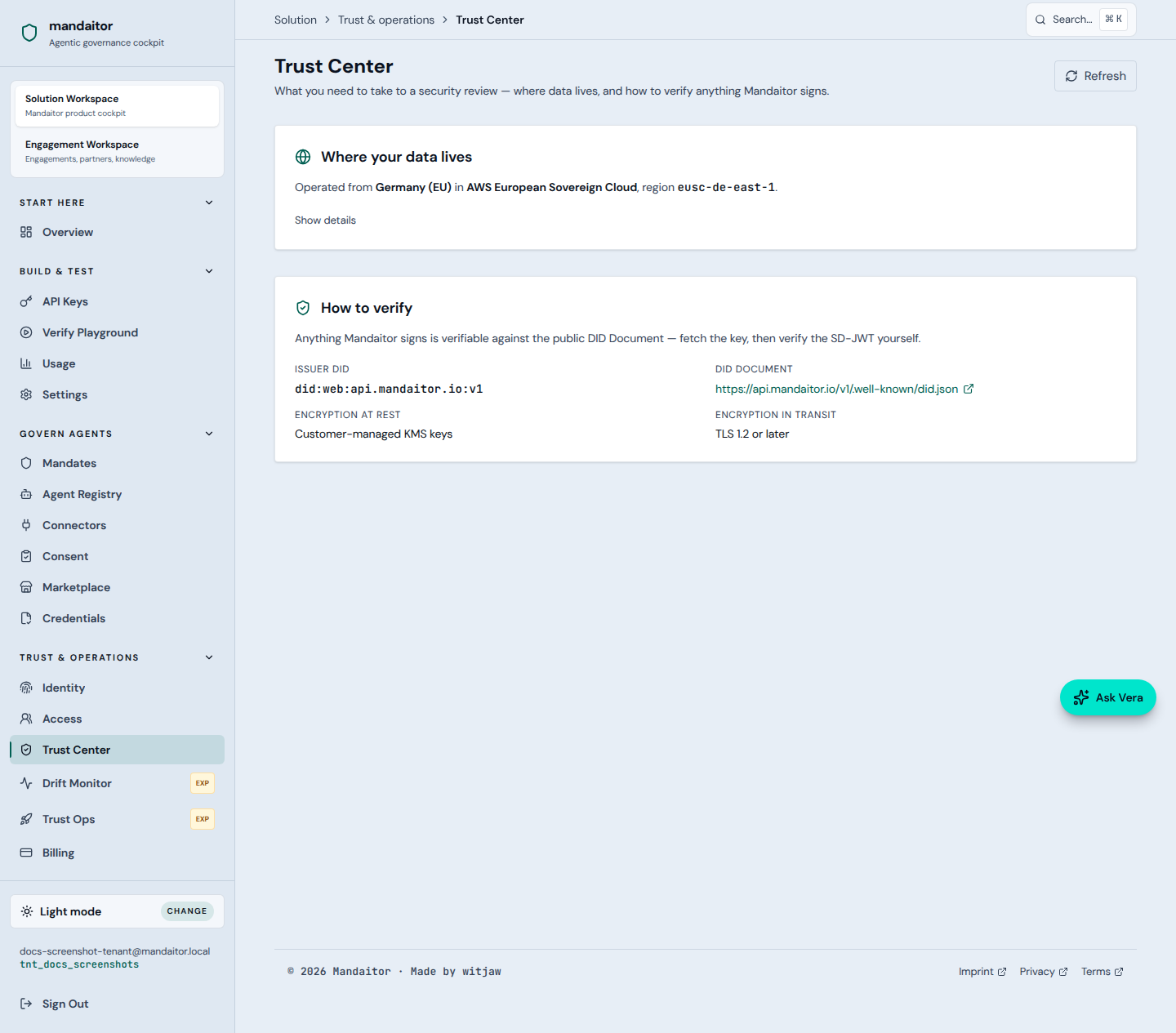
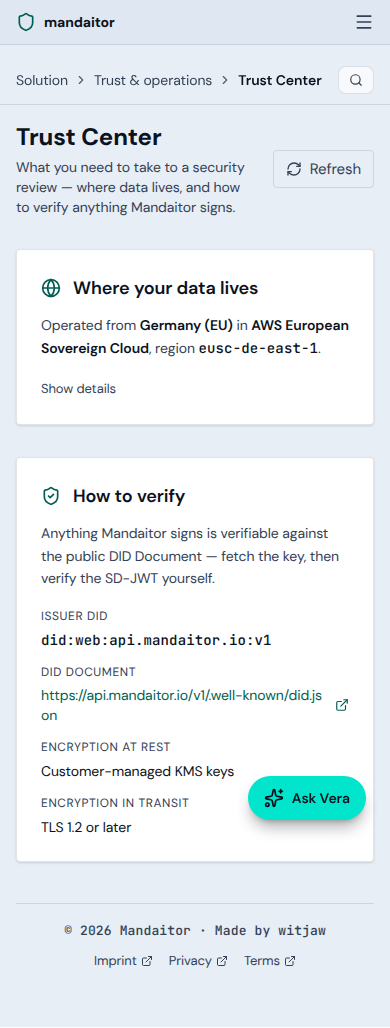
The product makes that distinction visible in the tenant Trust Center: verification outcomes, evidence signals, and posture indicators presented as inspectable trust material rather than a compliance checkbox.
- Desktop
- Mobile
| Term | Meaning in this Academy | Mandaitor contribution |
|---|---|---|
| Governance | The operating model for responsible authority and oversight. | Roles, mandates, lifecycle, review loops. |
| Risk | The possibility that agent action causes harm or exceeds authority. | Runtime verification and risk-aware evidence. |
| Compliance | Demonstrating alignment with internal or external requirements. | Evidence packs, audit trails, dashboard status. |
| Trust | Confidence that the system behaves within understandable boundaries. | Proof-of-Mandate, transparency, and verifiable decisions. |
Questions every team should ask
Teams evaluating Mandaitor should use governance questions as design prompts rather than as late-stage audit questions. The goal is to define the authority model before agents are connected to high-impact tools.
| Question | Why it matters | Where Mandaitor helps |
|---|---|---|
| Who can create mandates? | Prevents uncontrolled delegation. | Mandate lifecycle and approval controls. |
| Which actions require verification? | Focuses control where impact is highest. | Action taxonomy and policy enforcement. |
| Which evidence must be retained? | Supports audit, disputes, and incident response. | Evidence packs and audit events. |
| When must humans approve? | Balances automation and accountability. | Constraints, obligations, and escalation patterns. |
| How are revoked or expired mandates handled? | Prevents stale authority. | Status checks and verification decisions. |
Practice check: map authority evidence to a control
GRC control design
A risk team wants to approve agentic workflows only when high-impact actions have bounded mandates, runtime verification, escalation paths, and dashboard-visible evidence. The team needs a control statement that engineers can implement and auditors can test.
A good GRC control does not merely say that AI should be governed. It specifies what authority evidence must exist before, during, and after a risky action.
- Write the control objectiveState what the organization wants to prevent or prove for high-impact agent actions.
- Define test evidenceName the mandate, policy, decision, exception, reviewer, and evidence-pack artifacts that would prove the control operated.
- Describe failure handlingExplain what should happen when a mandate is missing, expired, ambiguous, or outside policy.
- Control testability
- The control can be tested with real artifacts, not only interviews.
- Risk alignment
- The control focuses on high-impact agent actions rather than every harmless interaction.
- Operational fit
- The control gives engineers a clear runtime pattern and gives reviewers a clear evidence trail.
What makes an agentic-AI governance control testable?
- It names the evidence artifacts that show mandate scope, runtime decision, escalation, and review outcome.
- It says that all teams should use AI responsibly without specifying any artifacts.
- It depends only on the model provider's general safety statement.
Reveal answer
A testable control links governance intent to artifacts. Mandates, policy versions, runtime decisions, exceptions, evidence packs, and reviewer actions let auditors check whether the control actually operated.
What to read next
Read Compliance Dashboard Explained to understand how governance signals appear in the product. Read Evidence Packs and Audit Events to understand the raw material behind those signals.
Save your learning progress
Mark this lesson as complete to update the Academy overview without requiring an account.